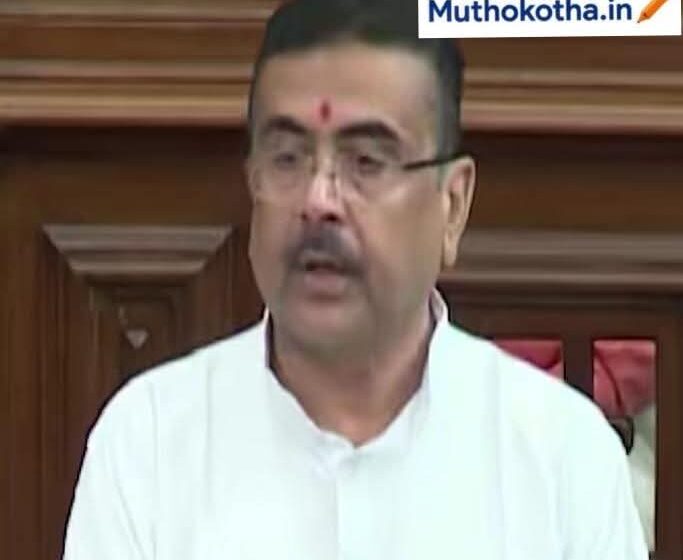
Chief Minister Suvendu Adhikari announces mandatory use of Bengali across all levels of state administration starting September 1, 2026.

July 21, Kolkata, muthokotha.in: The use of the Bengali language is set to become mandatory across the board—ranging from administrative tasks and citizen services to websites and forms. State Chief Minister Suvendu Adhikari announced that, effective September 1, 2026, the use of Bengali will be compulsory at all levels of government in West Bengal.
Speaking in the Legislative Assembly on Monday, Suvendu Adhikari stated, “From September 1, 2026, the use of Bengali will be made mandatory at every level of the state administration.”
He further revealed that Union Home Minister Amit Shah, during a three-day visit to the state, had written him a letter advising him to ensure the extensive use of Bengali in the state administration. The Chief Minister made this announcement after reading that letter aloud in the Assembly.
According to the Chief Minister, “Priority must be given to Bengali in all our government activities. It will take a month and a half to translate everything required for this; the government will undertake that task.”
As per government guidelines, the use of Bengali will become mandatory in the following areas starting September 1:
- Citizen Services: All government forms, certificates, and application forms.
- Digital Services: Government portals, websites, mobile applications, and digital governance systems.
- Administrative Work: Departmental letters, circulars, and notifications.
- Public Relations: Press releases, government advertisements, and training materials.
- Public Information: Government signage and police station communications.
However, the Chief Minister noted that Hindi would also be used for official correspondence between the state and the central government.
He also assured that the government would make the necessary arrangements, including hiring translators, to implement this process.
The Chief Minister stated that this step is aimed at preserving the culture and identity of Bengal. He remarked that the government is working with the guiding mantra of “Banglar Mati, Banglar Jol” (Bengal’s soil, Bengal’s water).
Since assuming power in the state, the Suvendu Adhikari-led government has taken several cultural initiatives. He has recently announced plans to make the singing of ‘Vande Mataram’ mandatory in schools and to introduce the Uniform Civil Code (UCC) and strict anti-conversion laws.
Immediately after taking his oath at Rabindranath’s ancestral home in Jorasanko, he had said, “The culture of Bengal and the Bengali people will flourish in line with the poet’s vision.”
Previously, during the tenure of the Trinamool government, the singing of the song ‘Banglar Mati, Banglar Jol’ was also mandatory in schools. In 2017, Chief Minister Mamata Banerjee had also announced plans to make Bengali a compulsory subject in schools.
Now, following its rise to power, the BJP government has adopted an even stricter stance regarding language policy. Suvendu Adhikari assumed office as the state’s ninth Chief Minister on May 9, 2026; he is the first BJP Chief Minister of the state.
The Chief Minister stated that the government would require another month and a half to implement this decision. During this period, all government documents, software, and forms will be translated into Bengali. It was also announced that interpreters would be appointed to assist with the translation process.
This announcement has elicited mixed reactions. Advocates of the Bengali language have welcomed the move, believing it will increase employment opportunities for Bengali speakers.
However, some government employees and business associations have expressed concerns that an abrupt shift to Bengali could lead to initial difficulties. They emphasize the need to focus on translation quality and staff training.
This directive, set to take effect on September 1, marks a significant step in West Bengal’s administrative history. The new government is striving to make language a cornerstone of administration, rather than merely a matter of sentiment.
It remains to be seen how much the government can accomplish in terms of preparation within this six-week window and how easily the general public adapts to the new regulations.