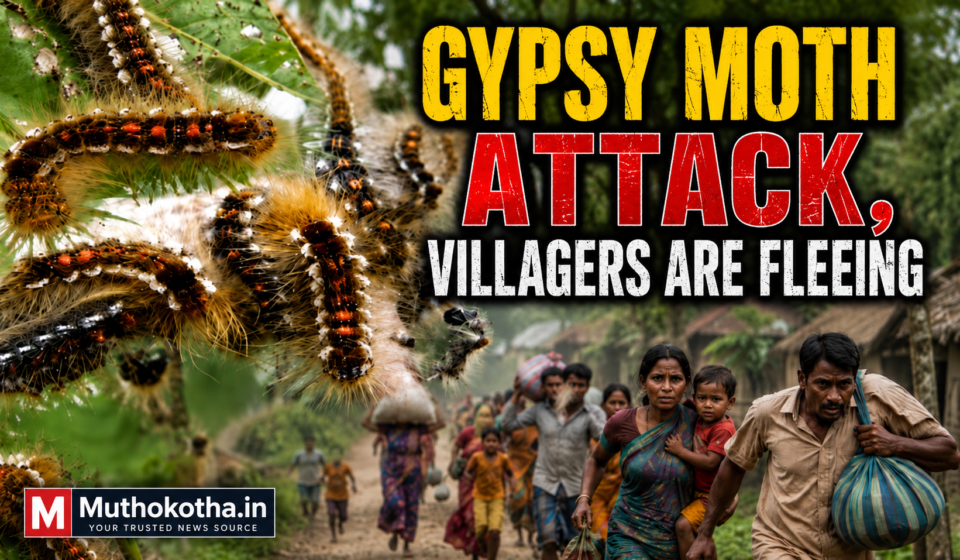
Villagers Flee Homes Due to Caterpillar Infestation; Hospitalizations, School and Kitchen Closures

Kalna, East Bardhaman, July 26, Muthokotha.in: In Barokobla village, the morning sky is filled with dark swarms. Yet, these are not clouds, but caterpillars. It is hard to believe that a tiny insect could wreak such havoc on the lives of an entire village unless one hears about the situation in Barokobla, located under the Srirampur Gram Panchayat of Kalna’s Purbasthali-1 Block. For nearly two weeks, hundreds of families in the area have been tormented by a severe caterpillar infestation. The situation has become so dire that some families, gripped by panic, have been forced to temporarily abandon their homes. Several children and elderly residents have even fallen ill and required hospitalization.
Swarms of caterpillars are descending in droves from tree leaves, jute fields, and drains. They have invaded every conceivable space—house walls, windows, kitchen cookware, food, and even drinking water.
The locals’ primary grievance is that the insects’ fine, toxic hairs are becoming airborne. These hairs are being inhaled and are settling on food, causing people to fall ill.
Contact with these hairs causes unbearable burning sensations and itching across the body, triggering allergic reactions, rashes, and—in most cases—reddening of the eyes. Respiratory distress and throat irritation are also common symptoms. Additionally, the contamination of food with these hairs is leading to vomiting and gastrointestinal issues.
Over the past ten days, more than 40 people have sought primary medical treatment. Five children and two elderly individuals required admission to Kalna Sub-divisional Hospital; three of them have not yet fully recovered.
Overcome with emotion, local residents said, “We cannot sleep at night. Our bodies itch constantly. Blisters have broken out on the children’s skin. Doctors say it is an allergic reaction to the insects’ hairs.” The situation is dire for about 30 to 35 families whose homes are adjacent to large jute fields; reports indicate that the infestation is most severe originating from these very fields. Compelled by circumstances, some have sought refuge with relatives, while others have moved to neighboring villages, forced to abandon their household belongings and livestock.
Elderly resident Saraswati Das said, “I have lived in this village for 60 years, but I have never seen days like these. One cannot even step into the courtyard; there are insects everywhere. Out of fear, I have come to stay with my son at his place. Who knows when I will be able to return home?”
Some villagers attribute the crisis to the massive scale of jute cultivation. “Jute farming has increased significantly in this area over the past few years with government encouragement. Jute plants are the favorite food of these caterpillars, and they are swarming into the inhabited areas from the fields. Pesticides were not applied properly during the harvesting period, and subsequent rains caused the insect population to multiply rapidly. Now, having exhausted their food source in the fields, they are invading the village,” they claimed.
Environmentalists believe that the sudden rainfall following a prolonged heatwave has accelerated the insects’ breeding process.
The residents are particularly aggrieved with the Srirampur Gram Panchayat and the Department of Agriculture. They allege that the Panchayat was informed in writing just three days after the problem began, yet no pesticides have been sprayed in the fields to date.
Ranjit Mondal, a local youth, said, “We have submitted deputations three times. The Panchayat Pradhan keeps saying he is ‘looking into it,’ but no vehicles or pesticides have arrived in the fields. Had timely action been taken, the situation would not have reached this point.”
The villagers are demanding the immediate spraying of pesticides and disinfectants across the entire area using drones or vehicles. They are also calling for financial assistance and free medical treatment for the affected families, as well as an urgent visit by an expert team from the Department of Agriculture to apply pesticides to the jute fields.
Normal life in the village has come to a standstill due to the caterpillar infestation. Student attendance at the primary school has dropped to 20 percent, as parents are afraid to send their children to class. Vegetable vendors are forced to keep their produce covered while selling, yet the insects’ irritating hairs still manage to fall onto the vegetables. Under these circumstances, most households have stopped cooking and are forced to bring food from eateries; however, the moment the food is left uncovered, these hairs fall into it. Work in the fields for cultivation has come to a halt.
Sources at the local BDO office indicate that the matter has been reported to higher authorities. A team from the Agriculture Department is expected to visit the area within the next 48 hours.
Agricultural expert Dr. Amitabha Sen stated, “This is likely a species of ‘hairy caterpillar.’ Their body hairs contain a substance similar to histamine, which triggers allergic reactions. Organic pesticides and pheromone traps must be used immediately; otherwise, the situation will worsen over the coming month.”
Health experts advise affected residents to wear full-sleeved clothing, cover windows and doors with mesh netting, and consume boiled water.
An entire village is being defeated by an insect.
This incident in Barkobola is not merely a village-specific issue; it is the result of administrative apathy and a failure to take timely action. The very villagers who contribute to the state’s economy by cultivating jute all year round are now being driven out of their homes because of that same crop.