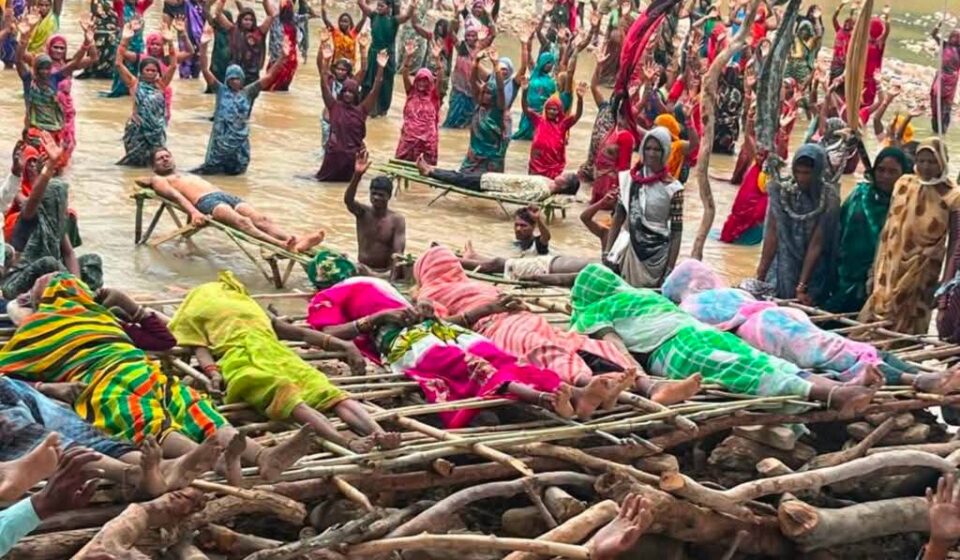

July 21, Muthokotha.in: An incident unfolding in the Chhatarpur and Panna districts of Madhya Pradesh has recently captured the nation’s attention. At first glance, it might look like a film shoot—people lying on funeral pyres, others crucified, or standing with nooses around their necks. Yet, none of them are actually dead; however, they are loudly declaring, “This is how we will die.”
The reason? They are losing their homes and land—everything they own—in the name of development. Consequently, these dispossessed people have taken to the streets to protest.
But who are they? What is their struggle about? It is natural to ask these questions. They are the Kol and Gond tribal people of Madhya Pradesh’s Chhatarpur and Panna districts. Women—ordinary, simple women—have redefined the language of this protest.
This struggle is not merely personal; it is not just about saving their own homesteads. It is a fight to save the forests, rivers, tigers, and nature itself.
At the heart of this is a Government of India initiative: the ‘Ken-Betwa River Link Project.’ According to official claims, the project will provide irrigation for 10.62 lakh hectares of land and supply drinking water to 62 lakh people, benefiting both Madhya Pradesh and Uttar Pradesh. In short, the project promises immense development.
But what are the local people losing in exchange for this promised development?
Reports indicate that:
21 villages will be wiped off the map.
Over 20 lakh trees will be felled, destroying vast stretches of forest.
A significant portion of the Panna Tiger Reserve will be destroyed.
Endangered species—such as tigers, gharials, and vultures—will face a severe crisis.
The climate, weather patterns, and the entire ecosystem will be jeopardized.
The tribal communities allege that the government has promised compensation and rehabilitation in the past but failed to honor those commitments. This time, they refuse to accept such assurances. They have but one demand of the government:
“They want development, certainly. But the people, the trees, and the wildlife must come first. Provide fair compensation. Ensure rehabilitation. Consider alternatives.”
These people do not live in city apartments; they reside in the lap of nature. Naturally, their primary concern is the natural world. They want the government to make decisions in compliance with the Panchayat (Extension to Scheduled Areas) Act and the Forest Rights Act.
The very Adivasis whose Gond folk art has showcased Indian culture on the global stage—whose paintings adorn the walls of upscale apartments—are now prepared to lay down their lives to protect their trees, wildlife, and peaceful coexistence.
We do desire development and the advancement of civilization. However, we do not want development achieved by destroying nature. Nature will exact its revenge. We must reflect on this before that retribution strikes; otherwise, everything will come to an end—and that day may not be far off.