
Alakesh Maity | July 18 | Muthokotha.in: Twenty-one consecutive days. Not even a drop of water. His body had collapsed, and he had lost a worrying 8 kilograms in weight. Reports indicate that in the early hours of Saturday, he was removed from the protest site at Delhi’s Jantar Mantar and admitted to the hospital. The hunger strike by 58-year-old Sonam Wangchuk—a Ladakhi social activist, educationist, and scientist—has sparked mixed reactions across the country. The Delhi Police were compelled to remove him from the protest site to save his life. Conversely, the protesters argue that the hunger strike was forcibly ended to “stifle democratic voices.”
The movement, which began with demands ranging from addressing the recent NEET scandal to calling for the Union Education Minister’s resignation, reached a critical juncture on the twenty-first day.
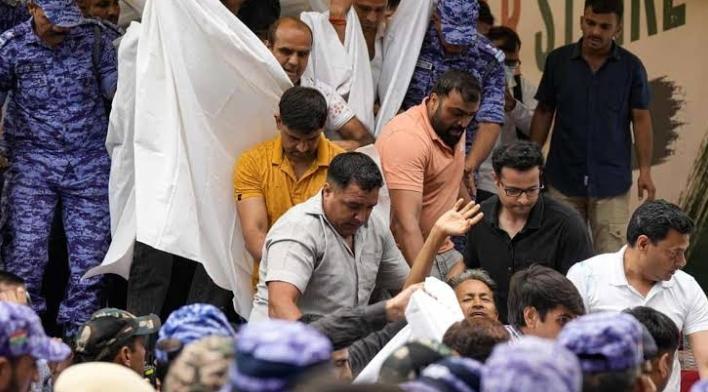
It is reported that police vehicles suddenly arrived at the Jantar Mantar protest site around 5 AM on Saturday, accompanied by an ambulance. After the prolonged fast, Sonam Wangchuk was barely able to speak. Although police officials tried to persuade him to end the fast, he remained unwilling to do so.
Eyewitnesses claim he was placed on a stretcher by force. Activists from the recently talked-about ‘Cockroach Janata Party’ were present; a scuffle ensued with the police when they attempted to intervene. Overcoming all resistance, the Delhi Police took Wangchuk to Ram Manohar Lohia Hospital.
According to special sources, his blood pressure, blood sugar, and electrolyte levels were critically low at the time of admission. Doctors believe the situation could have become dire had there been a delay of another 24 to 48 hours.
This movement began on June 20. The ‘Cockroach Janata Party’—which gained rapid momentum primarily through social media—launched the sit-in protest at Delhi’s Jantar Mantar to protest against the question paper leak and corruption associated with the recent NEET-UG examination. The primary demand of this movement was the resignation of Union Education Minister Dharmendra Pradhan.
Seven days into the protest—specifically on June 27—Sonam Wangchuk began a fast-unto-death. His argument was, “If the education system collapses, the country’s future becomes bleak. Students are driven to suicide out of despair, yet the government remains a silent spectator.”
For the first ten days, the media and political parties paid little attention to the movement. However, as the days passed, Wangchuk’s health deteriorated, and the pressure on the BJP government mounted. The hashtag #SaveSonamWangchuk began trending on social media.
On Friday, the Congress party added a new dimension to the movement. After maintaining a distance for twenty consecutive days, the party’s top leadership finally decided to stand by Wangchuk.
During a meeting of the Congress Working Committee, Sonia Gandhi recalled an incident from the past. In 1984, Sonam’s father, Sonam Wangyal, had gone on a hunger strike demanding Scheduled Tribe status for Ladakh. Indira Gandhi was the Prime Minister at the time and had personally visited Wangyal to persuade him to break his fast. Subsequently, Congress spokesperson Pawan Khera visited Wangchuk at Jantar Mantar. Highlighting the BJP government’s intransigence, he said, “The Modi government does not listen to democratic protests. So, please do not endanger your life. Please call off your hunger strike.”
Eventually, acting on orders from the High Court, the BJP government moved quickly to bring the hunger strike to an end. A division bench comprising Delhi High Court Chief Justice Devendra Kumar Upadhyaya and Justice Tushar Rao Gedela stated, “The central government must take immediate steps to safeguard the life of the fasting Sonam Wangchuk. Daily health check-ups must be conducted by government doctors.” The court further directed that if doctors recommended hospitalization, the government must comply immediately.
Within 36 hours of receiving this directive—early Saturday morning—the central government arranged for the termination of Wangchuk’s hunger strike through police intervention. Government sources stated, “We are simply complying with the court’s order.” The widely discussed Sonam Wangchuk is not merely an intellectual or an educationist; he established the ‘SECMOL’ school for students in Ladakh. Notably, he served as the inspiration for the character “Phunsukh Wangdu” in the globally acclaimed film *3 Idiots*. He has spearheaded vocal movements addressing a wide range of issues, including society, nature, education, the criminalization of politics, climate change, and the preservation of Ladakh’s environment.
His wife, Gitanjali J. Angmo, is an accomplished karate instructor and educationist—a figure who has largely remained out of the spotlight. While many prominent figures across the country urged Sonam to end his hunger strike, Gitanjali stood firmly by her husband’s decision. After ensuring he was admitted to the hospital on Saturday morning, she too traveled to Delhi.
Although Sonam has temporarily suspended his hunger strike, the ‘Cockroach Janata Party’ has declared that the movement will continue. Party leader Abhijit Deepak stated, “We will continue our sit-in protest until Sonam Sir recovers. This movement will persist until the Education Minister resigns.”
The Parliament’s Monsoon Session is approaching. As expected, the opposition has resolved to raise a storm over this issue during the session. Meanwhile, the BJP camp maintains a clear stance: “An investigation into the NEET issue is underway, and the guilty will certainly be punished.”
This situation has created contrasting scenes on the streets of Delhi. On one hand, a candlelight march by Wangchuk’s supporters is taking place at Jantar Mantar; on the other, a government-led narrative is circulating, claiming that “some people are playing politics with the students’ future.”
This movement began with the leak of an examination paper. Since then, its trajectory has evolved into a confrontation between the government and civil society. Only time will tell whether Sonam Wangchuk will recover his health amidst this life-or-death struggle, and whether the central government will accede to his demands. The eyes of the nation are now fixed on that crucial passage of time.