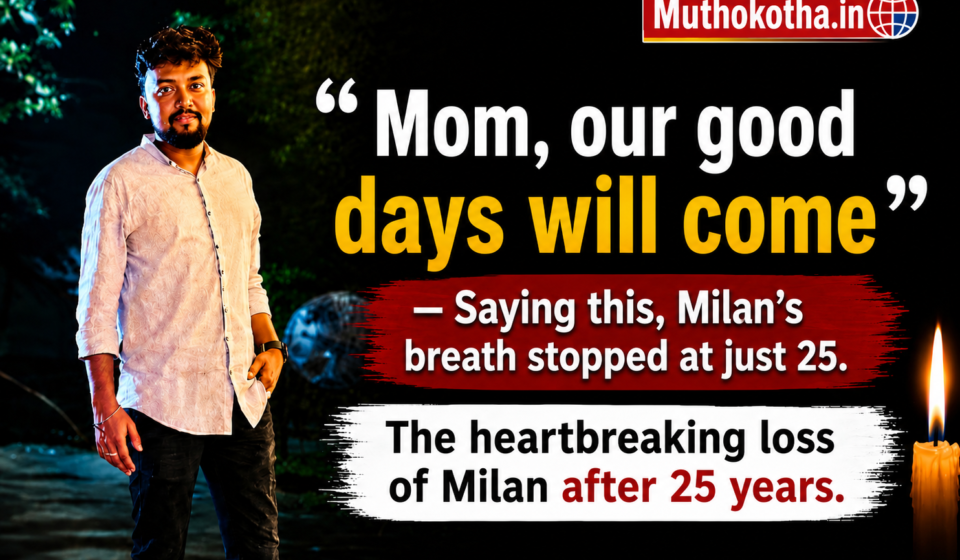
“Mom, better days are coming for us” — with these words, 25-year-old Milan breathed his last.

Alakesh Maity | July 29 | Patashpur, East Medinipur: A life spanning just 25 years. It held dreams as vibrant as a rainbow. His daily struggle was to build a modest home for his mother and younger brother. Then, one night, a dark cloud of nightmare descended, and it all came to an end.
Milan Sahu breathed his last late Monday night in a rented house in Egra. A deadly kidney ailment claimed the life of this quiet, gentle, and hardworking young man—a son who used to sleep clutching his mother’s sari-pallu, but who would never return to the land of his dreams.
The fatherless son’s struggle to build a life for his family was indomitable. Amidst that struggle, he harbored many dreams. Milan’s childhood was spent in abject poverty; he lost his father at a very young age. Since then, he had lived with his mother, Kajol Devi, and his younger brother at his maternal uncle’s house in Khar village, Patashpur.
After finishing his studies, he stepped into the workforce to lighten his mother’s burden. He started with a fast-food stall in Khar market, renting a room and managing everything himself. Later, he got an opportunity with Amazon India and moved to Egra for work. There, too, he lived in a rented house—a small family of three: mother, brother, and himself.
Neighbors say, “Milan was a wonderful young man. He never quarreled or lost his temper with anyone. He was very quiet and humble, handing over every penny he earned to his mother.”
Milan often told his mother, “Mom, stop working in other people’s homes. I am here for you.” But his mother, Kajol Devi, would not agree. Her constant refrain was, “Only if we both earn something can we ever build a small home of our own.”
The son dreamed of building a concrete house in his mother’s name. The mother dreamed of raising her son well. Both envisioned a bright, colorful future. But fate had painted a different picture.
A severe kidney disease was diagnosed about a year ago. His mother even took him to another state for treatment. For the past month, he had been undergoing dialysis twice a week. His body was failing, yet Milan never gave up working. He used to say, “I’ll go back to work after my dialysis, Ma.”
Doctors declared that a kidney transplant was the only hope. The cost? Around 16 lakh rupees. Yet, his impoverished mother did not lose heart. She made a desperate attempt to save her son by offering her own kidney. She reached out to relatives, neighbors, and voluntary organizations for help. But no one realized that both the mountain of money required and the precious time left were rapidly running out.
The hardest blow came when the doctor said, “Even if he receives his mother’s kidney, there is no guarantee he will survive.” Still, the mother refused to give up. She would say, “I will keep trying until the very end. You will get better, my son; nothing will happen to you. Everything will be fine.”
On Monday night, around 9 PM, the mother returned to their rented home in Egra with her son after his dialysis at Kolkata’s PG Hospital. Until 2 AM, Milan lay there, holding his mother close. In a weak voice, he said, “Ma, don’t worry. Our days ahead will be better.” His mother tried her best to lull him to sleep, gently stroking his head.
Around 2:30 AM, he suddenly suffered from severe breathing difficulties. In an instant, everything turned chaotic. Upon hearing the news, his maternal uncle, Amit Das, rushed over. Milan was taken to Egra Super Specialty Hospital, but the doctors could not save him. His twenty-five-year-long battle for life came to an end right there.
As the news spread, a crowd gathered at their rented home in Egra. His mother’s weeping would not cease; Kajol Devi kept losing consciousness. She cried out, “I wasn’t even given the chance to donate my kidney. As a mother, I couldn’t save my son.” His younger brother, Jhulan, sat in stunned silence, clutching his brother’s lifeless body.
Women from the neighborhood remarked, “You rarely find a young man like him. He would go hungry himself just to ensure his mother and brother were fed.”
Milan’s death is not merely a loss for one family; it poses a question to our entire system. A twenty-five-year-old man who wanted to shoulder the responsibility of his family—and for whose treatment raising 16 lakh rupees proved impossible—was he destined to be lost like this? Despite government assistance and the Swasthya Sathi scheme, the treatment ultimately stalled due to a lack of funds. His mother was even willing to donate her kidney, yet it was not to be.
Milan is gone. He has left behind unfulfilled dreams—both his own and his mother’s—a wish for a small home of their own, and those final words: “Things will get better.”
Today, that rented house in Egra is silent. The very place where mother and son used to talk about the future until two in the morning now echoes only with weeping. When young men like Milan Sahu are lost, society suffers a great loss, too. For they do not give up; they fight—fighting on, holding their mother’s hand, until their very last breath.